Anniversary
‘So, you are really sure you are not coming back?’ my colleague asked, leaning back on the desk of the auditorium. I was in Barcelona, speaking at a university seminar for the time since making the professional transition from academic research to secondary school teaching. I was catching up with fellow academics, some of whom I had not seen in years. One of them was inquiring about my new professional life, with a mixture of both curiosity and surprise.
‘Never say never, but it took me a very long time to take the decision to leave, and I am happy where I am right now’ I answered. ‘It’s funny’ one of my colleagues said, ‘I was completely convinced you were on a track to become a fully-fledged academic’. I smiled. I had heard it many times after leaving academia. I am not sure I had heard it that often before leaving.

This month marks my first anniversary of leaving academia. I have been on such a steep learning curve since moving to teaching that I sometimes must stop to catch my breath, to fence off the vertigo. So maybe this is what I am doing with this article. I am catching my breath. I am fencing off the vertigo.
When I read posts or Tweets about people leaving academia, they generally focus on the much different working conditions that former researchers face in industry. Less precarity. Sometimes, better salaries. Almost always, a better work-life balance. This is part of the story. It is a big part of the story. Higher education is a poorly retaining sector. 60% of UK-based academics surveyed by the University and College Union in 2022 said that they were to leave the sector within the next 5 years. At the end of the day, if it had not been for the consuming precarity that I experienced as an academic, I would have never thought of leaving.
But it is not the whole story. If people only moved away from academia because of the working conditions, many more would probably jump the ship, or at least jump it quicker, without spending so much time in deliberation.
I remember the day I noticed something was off. I was on campus, sitting at my desk, working on my book. I had just started the first year of a three-year postdoc, a job I had landed after eighteen excruciating months on the job market. I lifted the fingers from the keyboard, leaned against the back of the chair, and looked out of the window. It was an afternoon of early October, the air outside was already kind of cold, the sun was still shining through the leaves that were turning yellow.
The office was almost empty. It was almost empty most of the time. I looked at the people crossing the court in front of the entrance to my building. I felt it in my throat. That sensation that something was amiss. I wonder whether people who have been married for a long time feel the same about their life partners at some point. When you look at the other person and realize you don’t recognize yourself in it anymore.

Leaving academia was a prospect that I had been forced to consider every time I had received a job rejection over the past two years. I had dreaded even just the thought of it. Even though I had been working since I was a teenager, the feeling of failure that hit me every time I thought of the possibility not to work in Higher Education for the long run was so overwhelming that I had never been capable of lucidly think about what different career I could have built on the long term.
So, I did what most people do when they feel that something in a long-term relationship is off: I waited. I guessed there was a strong chance that my body and my brain were still adjusting to that medium-term stability after a long period of uncertainty. Like when you have been hiking a mountain and you reach a point where you can get some rest, only to be overwhelmed by vertigo.
I started recording the moments when I was feeling particularly energized. One Monday morning, I woke up feeling strangely euphoric. I thought at what I had been doing during the past two days. I ached in every bone of my body. I had spent the weekend ordering donations, scratching surfaces and chopping wood in the warehouse of a charity. It was not the nature of the job that made me feel that way.
What had catalyzed my energy levels was that I had been surrounded by people all the time. I had talked, I had been bored, I had laughed, I had whined. I had met people that I found nice and met people that I found insufferable. But being surrounded by people the whole day was such a break from my everyday routine that it had not mattered. I was starved of human contact. My problem with academia, in other words, was that it had become too lonely for me.

It took me four years since that day in my office before I felt completely ready to leave Higher Education behind. This is because moving out of academia is not just about changing your daily routine, your colleagues, the tasks you are contracted to do. The university works by getting you to self-identify with your research, by getting you to measure your worth against what you publish, by blurring the boundary between what you are passionate about and what you are contracted to do. It gets under your skin, up to that very point in your gut where you get punched every time you get a grant, a journal, or a job rejection. What would I be if I was not an academic? Would I regret leaving? Was I ready not to have people looking at me as if I were some sort of mysterious alchemist every time they asked what I did for a living?
Secondary teaching, in a way, is the contrary of academic research. While research requires protracted periods of deep focus, in the absence of external stimuli, teaching means undergoing short sessions of intense adrenaline rush every day, multiple times a day. It means anticipating what children will do or how they will react to a task and troubleshoot in advance. It means explaining, and being prepared to answer questions about everything, in the clearest possible way.
What I had not realized before starting teaching is that supporting teenagers who, by virtue of their own age, have not yet learnt how to self-regulate all their emotions obliges you to learn how to control yours. This has made me connect with parts of myself that I have never really identified with. Once, when my patience was running low, I have been surprised to feel expressions from my mother’s village dialect bubbling up in my throat. I inhaled, and then I exhaled. I sent the dialect back, to the bottom of my belly, where I did not even know it had been dormant this entire time.

Leaving academia, though, made me realize what is that had drawn me to it in the first place: the chance to connect with the more creative side of myself. I had wanted to start a PhD to allow myself the time to explore societal issues that I felt passionate about. As a working undergraduate student, I had not had the chance to indulge into that. I had prepared most of my exams without attending lectures, I had rarely had the time to attend events or trainings that were not a core part of my course. The days were too tightly packed between working, commuting, and studying. The PhD first, and the postdoc later, had allowed me the time and space to do get lost, and create – a book, research articles, newspaper posts. And now I missed it.
Finally free of the imperative to excel in everything, I have allowed myself to play with the arts: I have signed up to an improv theatre class, I am experimenting with photography, I opened a blog. The patent mediocrity I approach each of these activities with makes some of my creative colleagues go out mad. ‘I don’t understand, why have you decided to sign up to this? You don’t even have a camera!’ asked me a guy I met in my documentary photography workshop. I laughed. He laughed too.
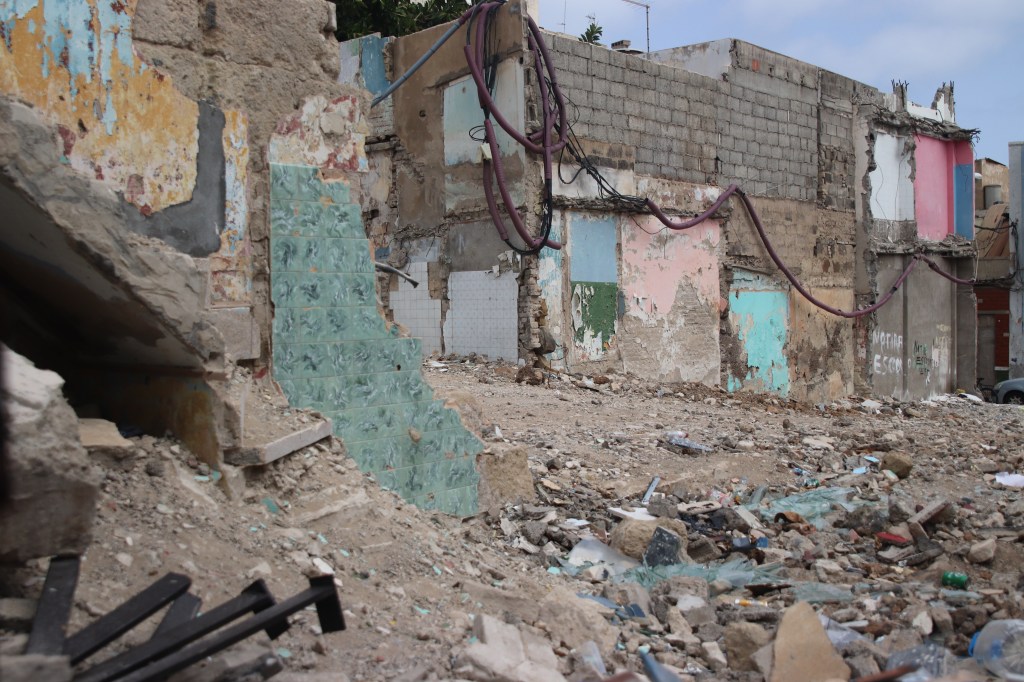
At the end of the day someone lent me a camera to join in the workshop. When I showed the rest of the group the pictures I had taken, a few of them asked me whether I was really into construction. I did not understand. And then I realized. Most of my pictures portrayed ruins. Worlds that had fallen apart, worlds that had been torn apart, willingly or unwillingly making space for something new to come.
 Lorena Gazzotti